

Industrial Poultry Feed Pellet Machine
- Available Capacities: 1-40+ T/H | Power: 22-315 kw
- Engineered for continuous industrial feed production
- Optimized for poultry feed formulations with controlled pellet size
- Steam conditioning system for improved feed digestibility
- Heavy-duty gearbox transmission for long-term stability
- Designed for integration into complete poultry feed production systems
Poultry Feed Pellet Machine: Complete Line Selection Logic
In modern poultry feed plants, the pellet mill is the core molding unit. Its rated capacity reflects performance under stable raw material preparation, controlled moisture, and continuous feeding.
Designed for industrial scale, the equipment integrates into the complete processing system. Connecting front-end equipment (grinders, mixers) to back-end units (coolers, crushers, packers), it bridges the entire production line.

1. Application Scenarios
Industrial poultry feed production for broilers, layers, ducks, geese, quails, and pigeons.
broilers
layers
ducks
geese
quails
pigeons

2. Raw Materials
Compatible with common poultry feed ingredients and commercial feed formulations.
Corn
Wheat
Soybean meal
Minerals
Fats/oils
Premixes

3. Pellet Diameter
Flexible pellet size configuration for different poultry species and growth stages.
2–12 mm
Fine Pellets
Large Pellets
Crumble Feed
Multi-Stage Feeding
Custom Configuration

4. Target Clients
Suitable for commercial poultry feed plants and industrial feed production projects.
Feed Mills
Poultry Farms
Breeding Groups
Integrators
Feed Companies
OEM Projects

5. Production Line Process
The feed pellet machine should match the entire feed production process.
Grinding
Mixing
Conditioning
Cooling
Crumbling
Formula Matching
Industrial Ring Die Pellet Mill Structure & Engineering Design
RICHI Industrial Poultry Feed Pellet Machine features a heavy-duty ring die system, specifically developed for continuous commercial feed production.
The entire unit is systematically engineered to ensure stable performance across three key aspects: torque transmission, material conditioning, and pelleting quality.
Ring Die & Pelleting Chamber
Feeding & Conditioning System
Drive & Transmission System
Structural Frame & Safety Design
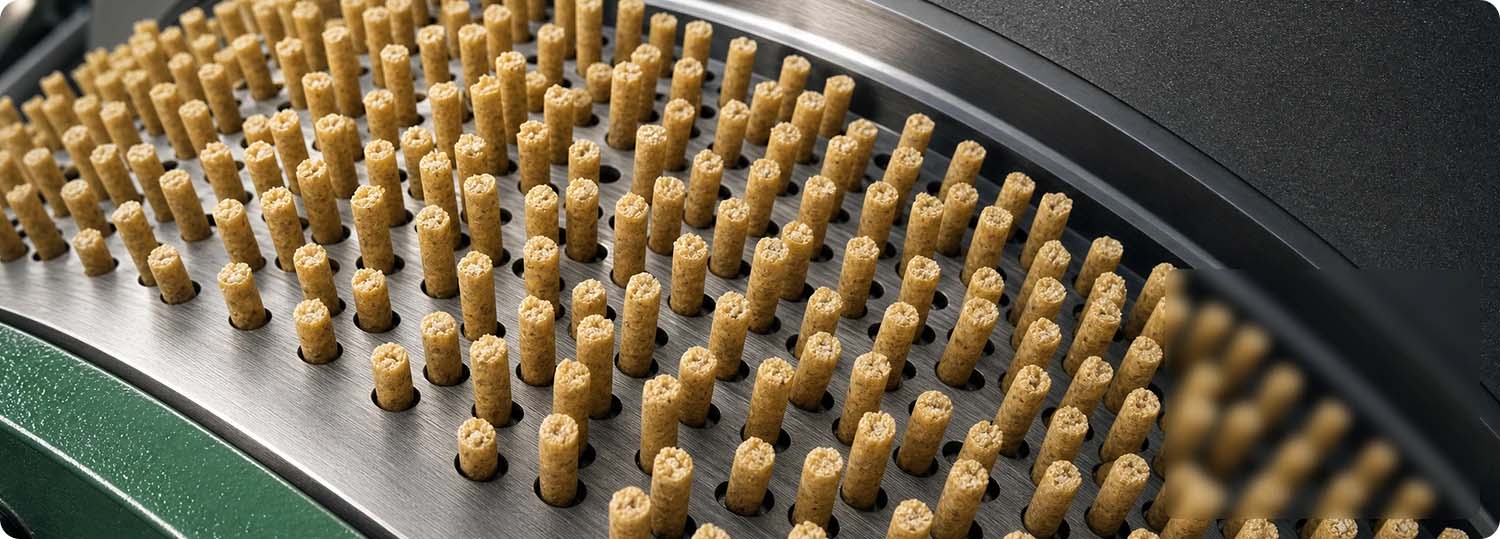
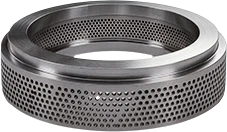
Ring Die & Pelleting Chamber
The ring die compression ratio is customized to match your feed formula. The die holes are CNC-machined for high precision, ensuring uniform pellets with a low fines rate.
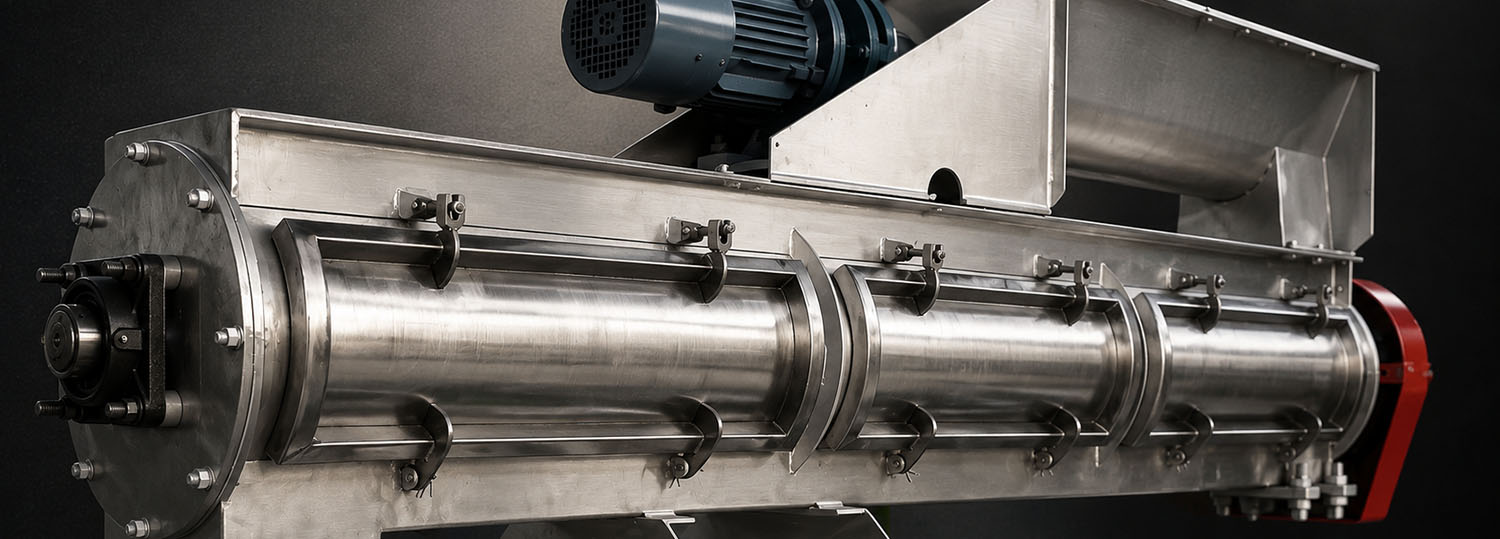
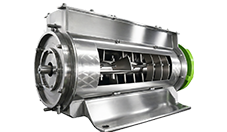
Feeding & Conditioning System
Equipped with a variable-frequency forced feeder, it ensures continuous and even material flow into the stainless steel conditioner. This prevents blockages and cross-contamination caused by material residue.
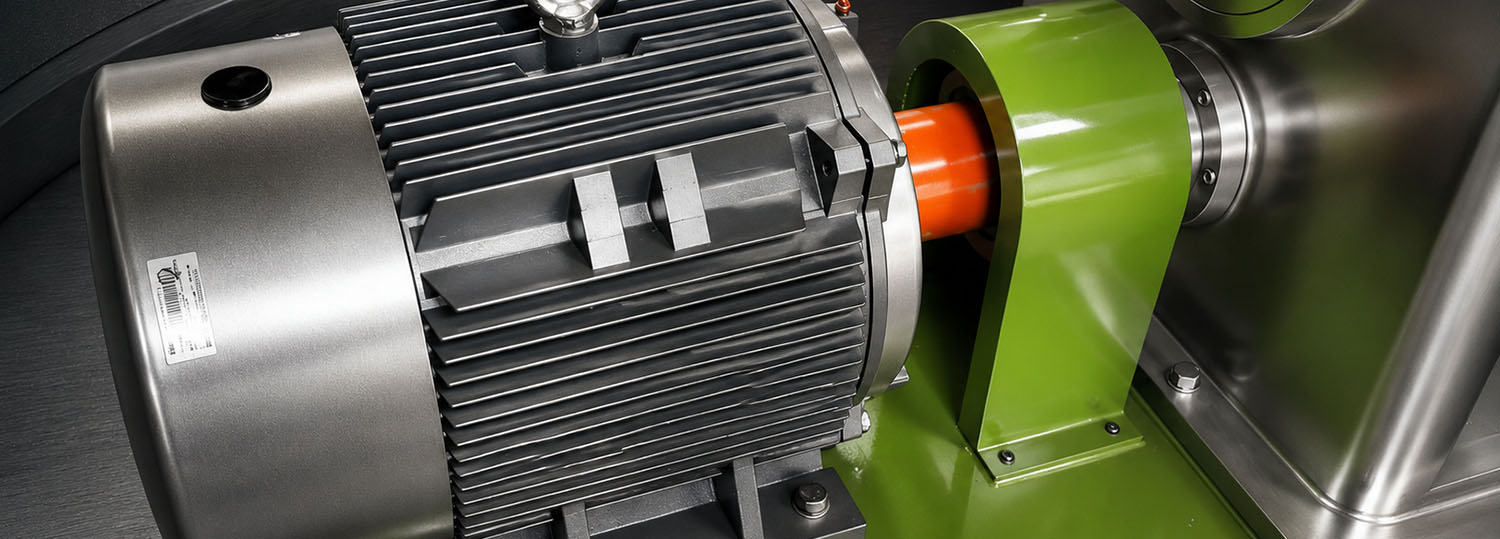
Drive & Transmission System
Features a high-precision gearbox transmission. It delivers high torque efficiency without slipping, eliminates belt wear issues, and guarantees superior long-term stability.
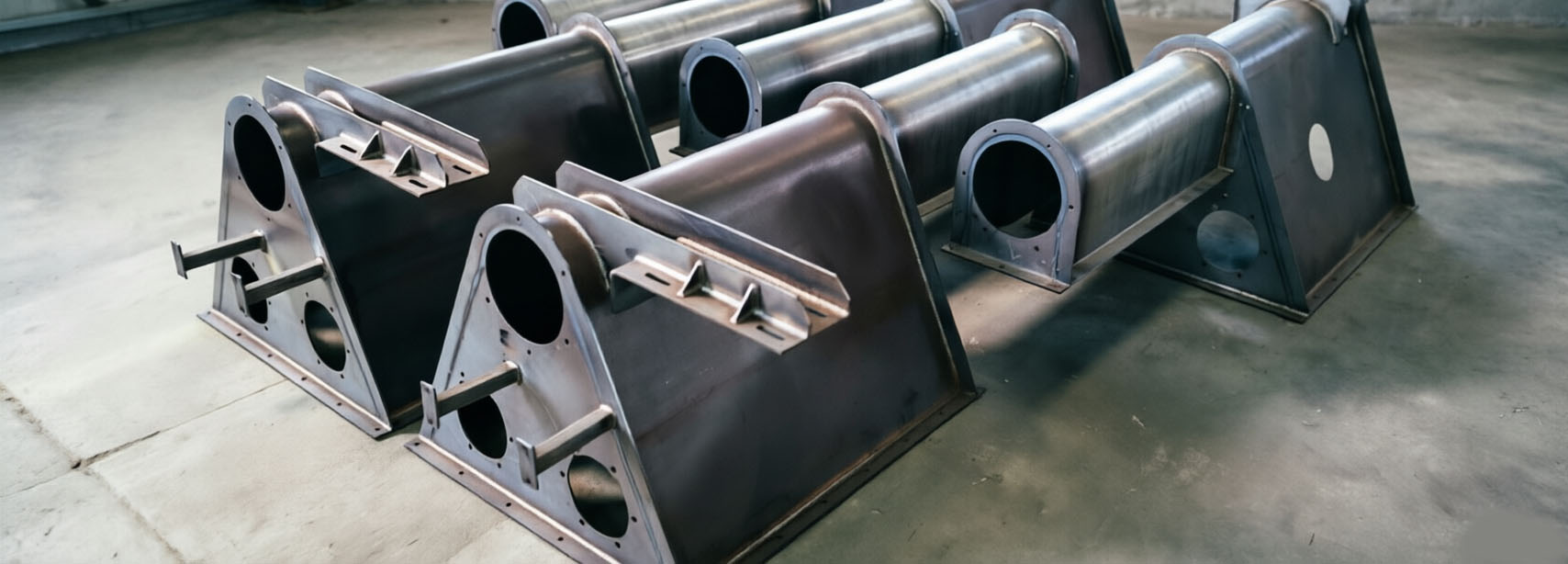
Structural Frame & Safety Design
Built on a high-strength steel chassis with integrated welding, the rigid structure ensures stable operation even under high-vibration conditions.
Pellet Mill Specifications & Technical Parameters
The following parameters are the rated output for a complete feed production line. Actual capacity depends on raw material prep and batching stability. Allow for a margin based on material traits and process conditions during selection.
Animal Feed Pellet Mill
| Model | SZLH250 | SZLH320 | SZLH350 | SZLH420 | SZLH508 | SZLH558 | SZLH678 | SZLH768 |
| Main Motor Power (kw) | 22 | 37 | 55 | 110 | 160 | 185 | 250 | 315 |
| Feeder Power (kw) | 1.1 | 1.5 | 1.5 | 1.5 | 1.5 | 1.5 | 1.5 | 2.2 |
| Modulator Power (kw) | 1.5 | 4 | 4 | 7.5 | 7.5 | 11 | 11 | 11 |
| Ring Die Inner Diameter (mm) | 250 | 320 | 350 | 420 | 508 | 558 | 673 | 762 |
| Finished Pellet Diameter (mm) | 2~12 | |||||||
| Output (t/h) | 1.0-1.5 | 3-4 | 5-6 | 10-12 | 15-16 | 20-22 | 30-33 | 38-40 |
| Note:Specs subject to final quotation. RICHI offers professional custom design and production. Final interpretation rights belong to RICHI. | ||||||||
Pelletizing Parameters & Ring Die Configuration Guide
| Poultry Species | Growth Stage | Recommended Pellet Diameter (mm) | Suitable Ring Die Inner Diameter (mm) | Notes |
| Broiler Chicken | 0–10 days (chick) | 0.8–1.5 (crumble feed) | Pellet mill + crumbler | Fine feed is recommended to avoid difficulty in intake |
| 11–25 days (young) | 1.5–2.5 | Pellet mill + crumbler | Gradually transition to larger pellet size | |
| 26 days–market (finisher) | 3.0–4.5 | 3.0–4.5 | Larger pellets improve intake and reduce waste | |
| Layer Chicken | 0–6 weeks (starter) | 1.5–2.0 | Pellet mill + crumbler | Fine particles recommended for starter feeding |
| 7–16 weeks (growing) | 2.0–3.0 | Pellet mill + crumbler | Develops gizzard function, avoid overly fine feed | |
| 17 weeks–laying period | 3.0–4.0 | 3.0–4.0 | Standard layer feed pellets | |
| Meat Duck | 0–7 days (duckling) | 1.5–2.5 | Pellet mill + crumbler | Higher feed intake, slightly larger pellets acceptable |
| 8–21 days (growing) | 2.5–3.5 | Pellet mill + crumbler | ||
| 22 days–market (finisher) | 4.0–6.0 | 4.0–6.0 | High feed intake, larger pellets suitable | |
| Layer Duck | Starter stage | 2.0–2.5 | Pellet mill + crumbler | |
| Growing stage | 2.5–3.5 | Pellet mill + crumbler | ||
| Laying stage | 3.0–4.0 | 3.0–4.0 | Avoid overly large pellets to prevent selective feeding | |
| Goose | 0–10 days (gosling) | 2.5–3.0 | 2.5–3.0 | Larger body size allows slightly coarser feed |
| 11–30 days (growing) | 3.0–4.0 | 3.0–4.0 | ||
| 31 days–adult | 5.0–8.0 | 5.0–8.0 | Coarse pellets are more suitable | |
| Quail | 0–2 weeks (starter) | 1.2–2.0 (crumble feed) | Pellet mill + crumbler | Small body size requires fine feed |
| 3 weeks–laying/market | 2.0–3.0 | 2.0–3.0 | ||
| Pigeon | Squab / juvenile | 1.5–2.5 | Pellet mill + crumbler | Small pellets or crumble feed recommended |
| Young/adult breeder | 2.5–3.5 | 2.5–3.5 | Moderate pellet size preferred | |
| Note: Pellet size varies with formulation, raw materials, and rearing mode. Crumbles are advised for young poultry to improve consumption rate. | ||||
Performance Advantages in Commercial Poultry Feed Production
An excellent pellet machine ensures consistent output and quality under high-load, continuous operation. It minimizes energy and maintenance costs over time and integrates smoothly into the full feed line, instead of running in isolation.
1.
Stable & Predictable Output
In commercial feed production, stability matters more than peak capacity.
Our precision ring die system, paired with a heavy-duty gearbox, ensures stable torque and uniform pelleting under continuous load.
This helps feed mills achieve predictable daily output and minimizes fluctuations.
2.
High Pellet Durability, Low Fines Rate
Pellet durability directly impacts transport, storage, and feeding efficiency.
The optimized conditioning system improves starch gelatinization, ensuring uniform compression.
This results in harder pellets with lower breakage during cooling, effectively reducing material loss.
3.
Optimized Energy Consumption per Ton
Energy efficiency determines long-term operating costs.
The industrial-grade gear drive minimizes mechanical loss while maintaining stable chamber pressure.
It balances motor power with die compression ratio to achieve higher output with lower energy input.
4.
Long-Term Mechanical Reliability
Commercial feed plants demand continuous operation.
The reinforced frame, precision-machined ring die, and industrial-grade bearings are designed for high-load production.
Key components use high-strength wear-resistant materials to reduce unplanned downtime, extend maintenance intervals, and ensure uninterrupted production.
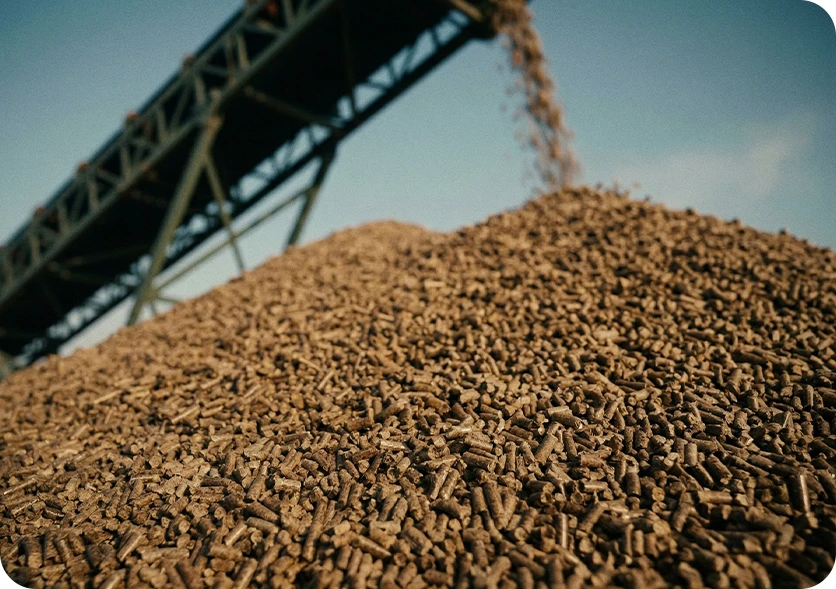
Poultry Feed Pelleting Built for the Scale You Operate
The industrial poultry feed pellet machine adapts to various production scales and feed formulas. Model selection is determined by capacity needs, poultry species, pellet size, and overall plant configuration.
Small-Scale Poultry Feed Pelleting Machine (1-2 t/h)
Medium-Scale Poultry Feed Factory (3-5 t/h)
Large-Scale Poultry Feed Plant (8+ t/h)
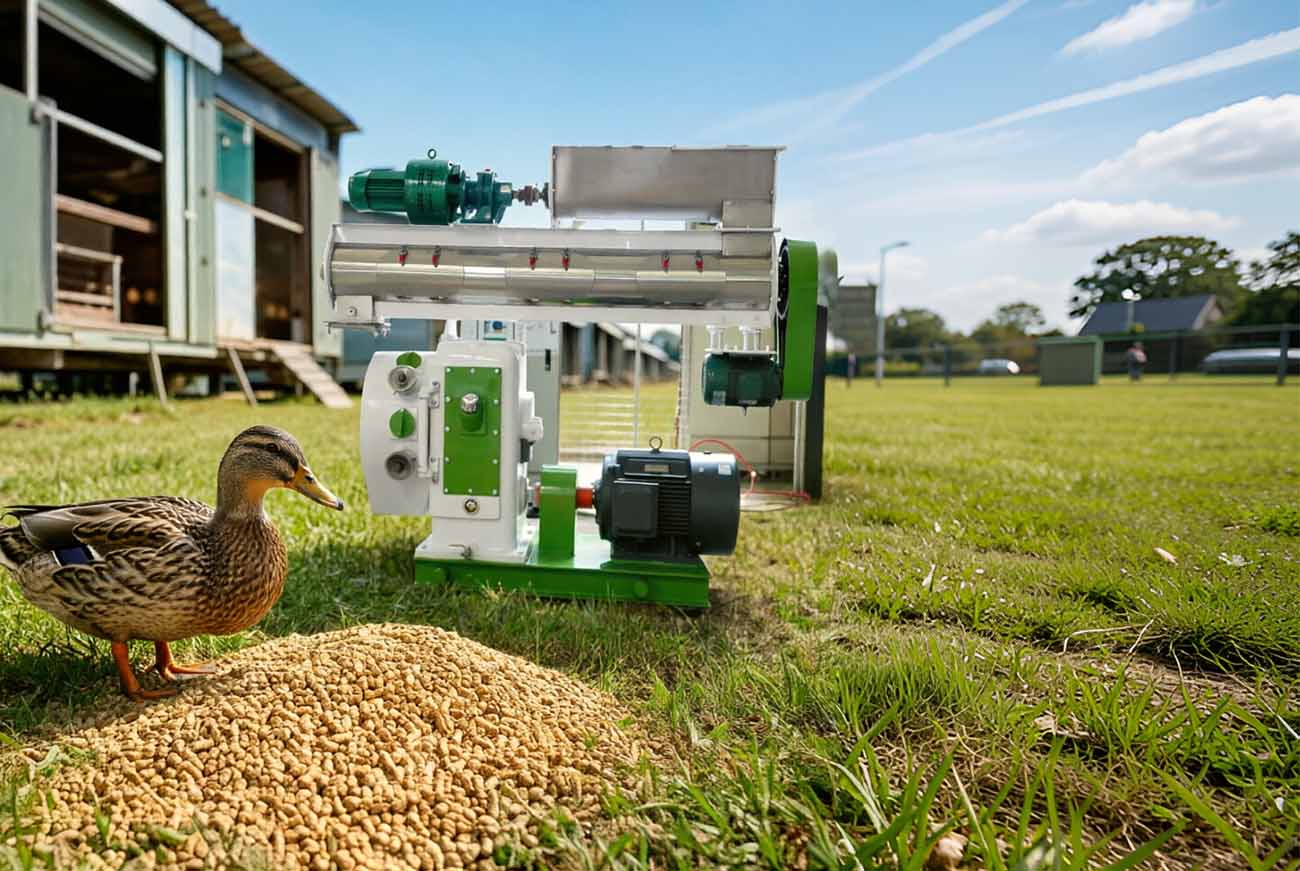
Small-Scale Poultry Feed Pelleting Machine (1-2 t/h)
Suitable for: Semi-automatic configurations with stable raw material preparation.
Typical Applications:
- Broiler starter and grower feed
- Egg layer feed for regional farms
- Independent poultry feed processing
Recommended Pellet Diameter:
- Broiler Starter: 2-3 mm
- Broiler Grower: 3-4 mm
- Layer Feed: 2-3 mm
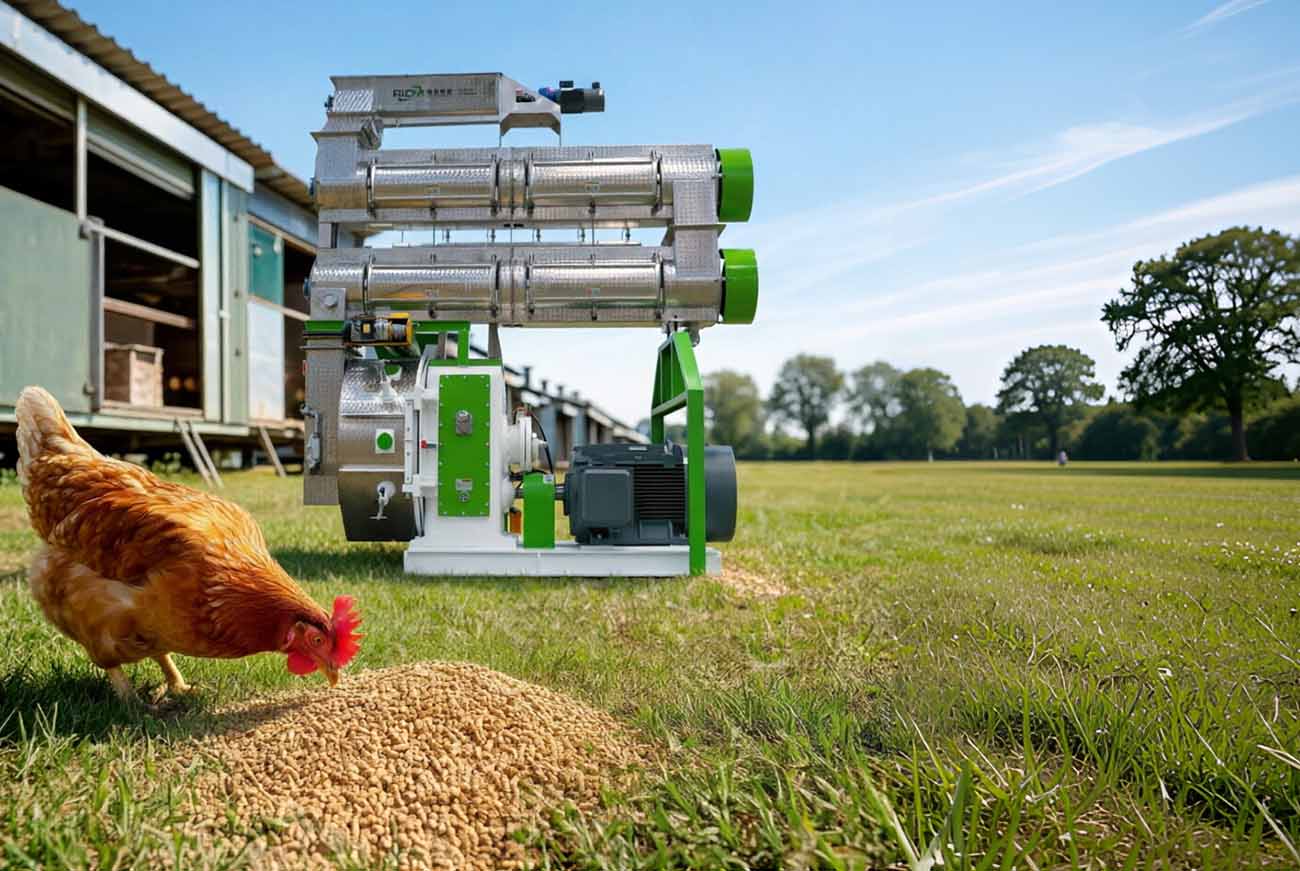
Medium-Scale Poultry Feed Factory (3-5 t/h)
Suitable for: Integration with automatic batching and conditioning systems to ensure pellet consistency.
Typical Applications:
- Integrated poultry farming operations
- Multi-formula feed production
- Commercial feed supply projects
Recommended Pellet Diameter:
- Broiler Feed: 3-4 mm
- Layer Feed: 2-4 mm
- Breeder Feed: 3-4 mm
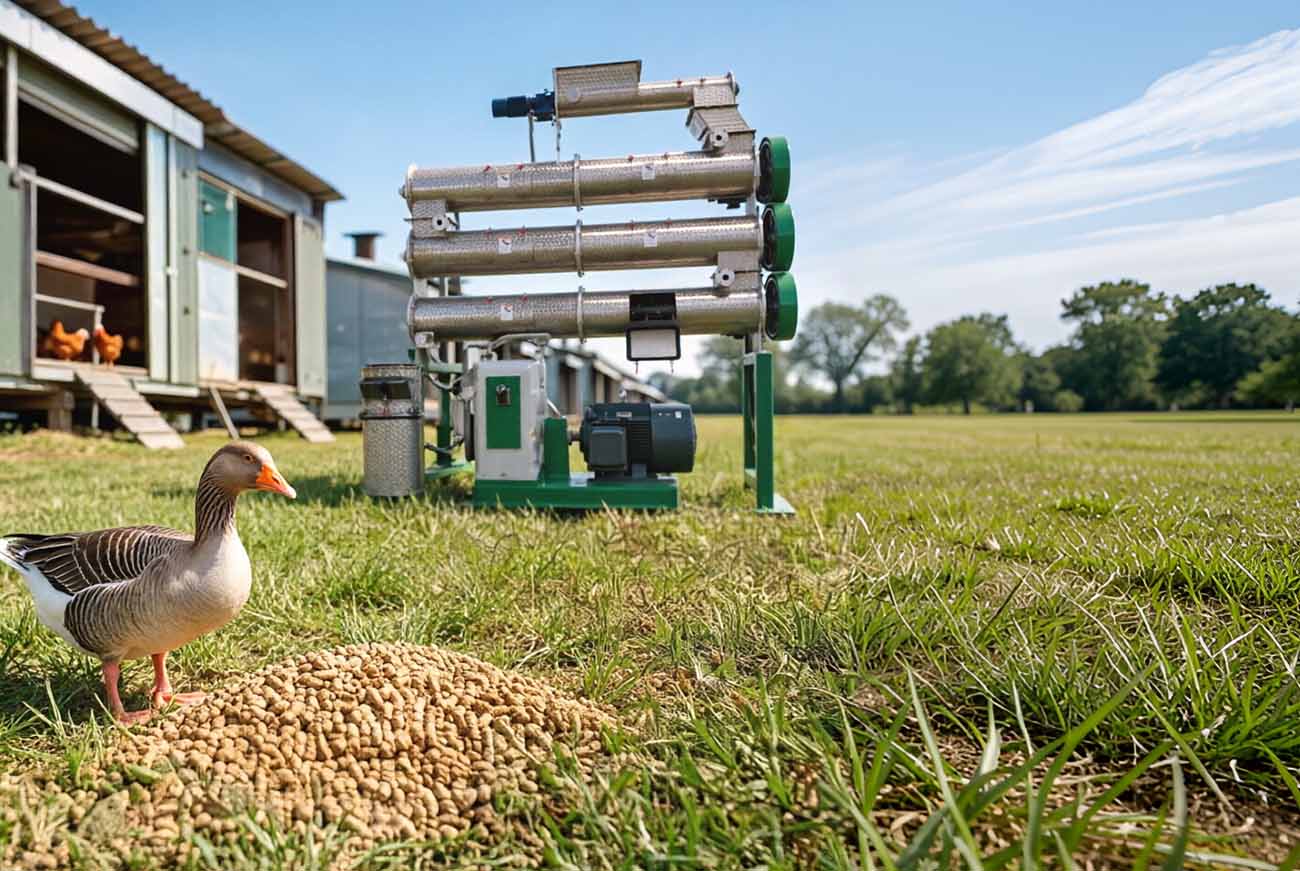
Large-Scale Poultry Feed Plant (8+ t/h)
Suitable for: Equipped with fully automatic batching and double/multi-layer conditioning systems, working in full-line coordination with upstream and downstream equipment.
Typical Applications:
- Feed mills supporting large breeding groups
- Specialized commercial feed production bases
- Export-grade feed processing projects
- Simultaneous production of multiple varieties and formulas
Typical Applications:
- Broiler Feed: 3-4.5 mm
- Layer Feed: 3-4 mm
- Duck Feed: 4-6 mm
- Goose Breeder Feed: 5-8 mm
From Pellet Machine to Complete Poultry Feed Mill
The pellet machine is the core of the feed line, but its performance relies on matching upstream and downstream systems. Process integration and capacity balance across all stages determine the line’s efficiency and final product quality. Integrating pelleting into a full-process design is key to stable production and cost optimization. (Click to flip and view details.)
01.
Raw Material
Processing
Once received, raw materials undergo screening to eliminate coarse impurities. Cleaned materials are stored in dedicated silos with clear labeling.
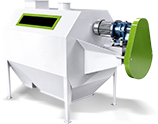
Rotary Drum Cleaner
Removes stones, sand, and heavy impurities from granular materials.
Capacity
15-50 T/H
Drum Speed
12-21 rpm
02.
Raw Material Crushing & Pellet Size Control
Grinding granularity is adjustable to match various poultry breeds and growth stages.
After grinding, the material is mechanically conveyed to the batching bin, ready for use.
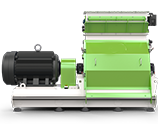
Hammer Mill
Grinds materials (≤5cm in size) into powder; screen mesh size is customizable.
Capacity
3-50 T/H
Grinding Size
0.5 – 20mm
03.
Batching & Mixing
Utilizes electronic weighing scales controlled by a PLC. Once weighed, the materials are fed into the mixer.
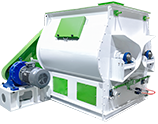
Twin-Shaft Paddle Mixer
Designed for mixing powders, granules, flakes, lumps, irregular materials, and viscous substances.
Material
Carbon Steel, Stainless Steel
Batch Capacity
250-2000 kg/P
04.
Conditioning & Pelleting
The mixed powder is conditioned with high-temperature steam. Next, it is fed into the ring die pelletizer for pelletizing. The die aperture is adjustable.
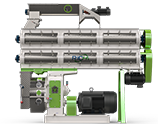
Poultry Feed Pellet Machine
Efficiently compresses powder into robust, durable pellets.
Power
22-315 kW
Capacity
1-40 T/H
05.
Cooling
The hot, high-moisture pellets are cooled and dehumidified to reach room temperature and safe storage moisture levels.
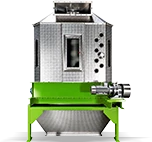
Counterflow Cooler
Cools high-temperature pellets to reach room temperature.
Cooling Time
6-15 min
Capacity
1-40 T/H
06.
Screening
The cooled pellets are graded via a vibrating screen to remove powder and fines.
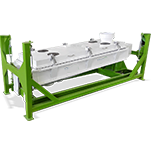
Rotary Grading Screen
Screens granular materials into large, medium, and small finished products.
Capacity
3-40 T/H
Power
1.5-5.5 kW
07.
Packaging & Automated Control System
Electronic scales allow custom packaging (10kg-50kg or ton bags). Fully automated lines with optional robots. Control modes: Manual, semi-auto, or full-auto.
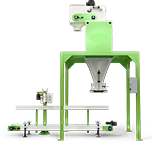
Fully Automatic Packing Scale
Packages materials, with sealing options: heat sealing, thread sewing, or hybrid sealing.
Packaging Speed
2-8 min/bag
Animal Feed Plant Engineering Projects
Serving the global market, we support large breeding groups and feed production enterprises. The following cases showcase our full animal feed production line projects across various scales and categories. Every solution is proven by large-scale production.
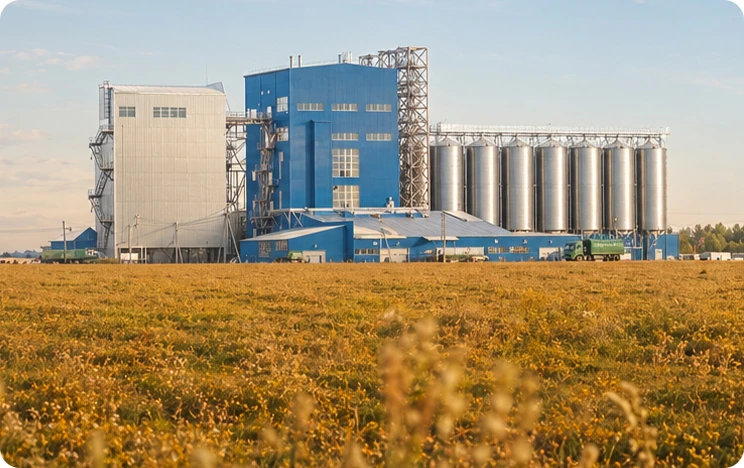
10 Poultry Feed Production Line In Algeria
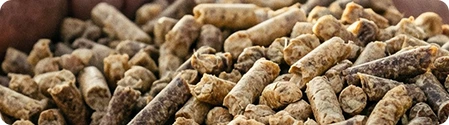
Region : Africa
Application : poultry feed production line
Output : 10 T/H
Product Type : feed
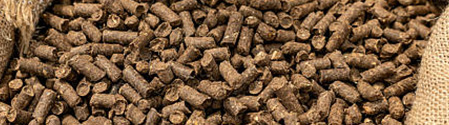
3-5 t/h complete chicken feed pellet production line in Zimbabwe
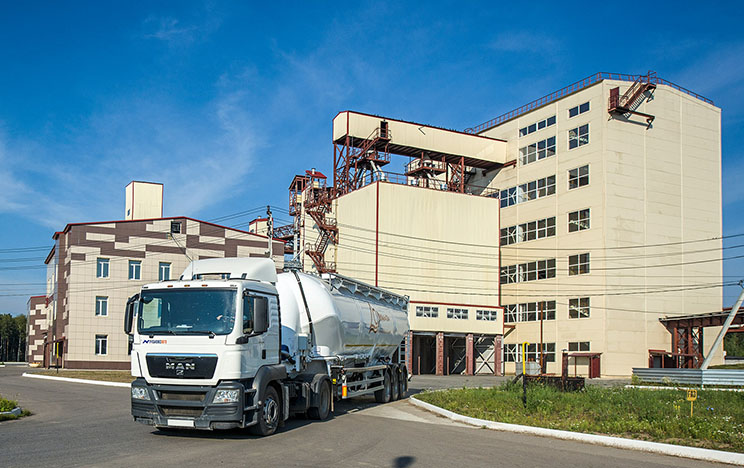
Region : Africa
Application : chicken feed production line
Output : 10-15 T/H
Product Type : pellet feed
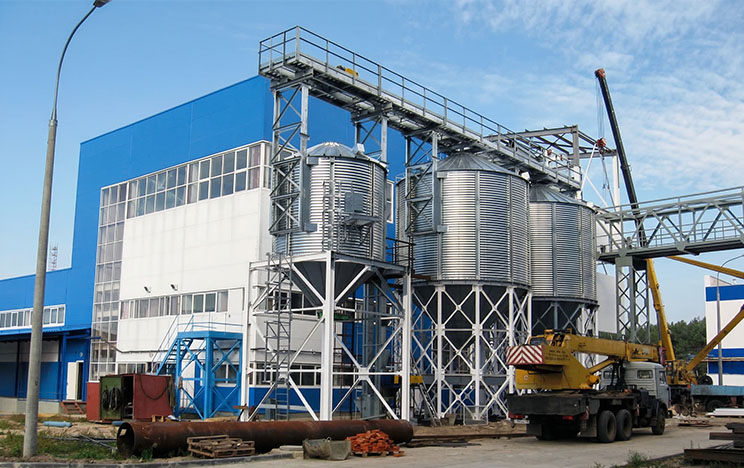
5 T/H Animal Powdered Feed Production Line In Kenya

Region : Africa
Application : animal feed production line
Output : 5T/H
Product Type : powdered feed
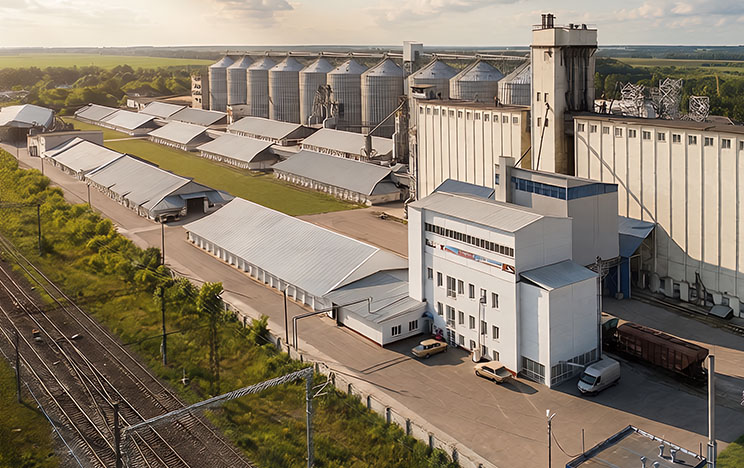
5-6 T/H Animal Feed Plant In Ethiopia
Region : Africa
Application : animal feed production line
Output : 5-6 T/H
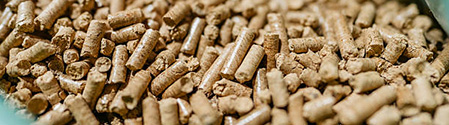
Product Type : pelletized feed
Poultry Feed Production Questions Answered
Find professional answers to common questions, covering the key processes and important considerations in animal feed production.
1. What are the advantages of pellet feed over mash feed for animals?
Pellet feed outperforms mash feed in three key areas: feeding, digestion, and storage.
2. How to choose the right pellet diameter for different poultry breeds?
Different poultry breeds—and even different growth stages of the same breed—require different pellet sizes. The general rule is: use small pellets for young birds and larger pellets for adult birds.
Specially:
- Broilers: 2-3 mm for the starter phase, increasing to 3-4.5 mm for the grower phase.
- Layers: 2-4 mm throughout the cycle; use smaller sizes for chicks and larger sizes during laying.
- Ducks: Require larger pellets, 4-6 mm is ideal.
- Breeder Geese: Eat coarser feed, 5-8 mm works well.
- Small poultry (Quails, Pigeons): 2-3 mm is sufficient.
When selecting a pellet machine, the ring die aperture should be based on your main breed. If you raise multiple breeds, we suggest choosing a medium size or equipping the machine with two sets of dies for flexible switching between batches.
3. What materials can this feed pellet mill process?
The machine’s material adaptability depends on the ring die compression ratio and the conditioning system.
It can stably process common raw materials like corn, soybean meal, wheat, rapeseed meal, cottonseed meal, and rice bran. When adding fats, minerals, vitamins, or premixes, stable pelleting is achieved by adjusting the conditioning parameters and die structure.
In practice, both the physical properties (grinding size, moisture) and chemical composition (fiber and fat content) affect pelleting results.
For high-fiber or high-fat formulas, please specify your process requirements during the selection stage so we can match the appropriate compression ratio and conditioning setup.
4. Can I use this pelleting equipment if I want to make my own feed?
Yes, our feed pellet equipment is suitable for on-farm feed production. However, whether it runs cost-effectively depends on your farming scale and supporting facilities.
Making your own feed saves on raw material costs and offers formula flexibility. But two key factors must be considered:
Economic Output: Your daily output must reach the machine’s economic operating range. Low capacity leads to high energy and depreciation costs per unit.
Supporting Equipment: You need front-end equipment for grinding and mixing. A single pellet machine cannot process raw materials into finished pellets on its own.
We recommend clarifying your farming scale and expected daily output first, then conducting a comprehensive assessment based on your current site and equipment.
5. How is the feed pellet formed in pelleting process?
At the Machine Level:
When the pellet machine operates alone, the process is: Powdered material → Variable-frequency feeding → High-temperature conditioning (steam + water) → Die-roller extrusion → Cutter trimming → Pellet output.
The material enters the conditioner evenly via the feeder. Mixed with high-temperature steam and water, the starch gelatinizes and proteins denature, improving binding and plasticity. Then, in the pelleting chamber, the material is pressed into the die holes by the rollers to form a dense pellet column. Finally, a cutter trims the extruded column to the set length, outputting the finished pellets.
At the Production Line Level:
In a complete feed production line, the pellet machine is the core unit, working with upstream and downstream equipment:
Front-end Process: Raw materials are cleaned and ground to the right size, then accurately weighed and mixed according to the formula. The mixed powder is lifted to the pellet machine’s bin.
Pelleting Process: The powder enters the pellet machine for conditioning, extrusion, and cutting, producing hot and moist pellets.
Back-end Process: The pellets enter a counter-flow cooler to lower temperature and moisture to safe storage levels. Then, a rotary screen removes fines and broken pellets. Finally, the product is weighed and packaged for storage.
The entire line is controlled by a central system, ensuring continuous production from raw materials to finished products.
6. What key factors should be considered when selecting a poultry feed pelletizer?
Selecting a poultry feed pellet machine involves more than just target capacity. It requires a comprehensive evaluation of raw material characteristics, desired pellet specifications, and the compatibility of the entire production line.
- Front-end Processing: The fineness of grinding and mixing uniformity directly impact the conditioning and pelleting results.
- Core Parameters: Conditioning temperature, moisture control, and the ring die compression ratio determine pellet hardness, durability, and the amount of fines.
- Downstream Matching: The capacity of downstream equipment—such as coolers, crushers, and sifters—must match the pellet machine to prevent bottlenecks and ensure stable operation.
Therefore, in practice, the pellet machine must be configured and coordinated as part of the complete feed production system.
7. What is the price of a poultry feed pellet machine?
The price of a poultry feed pellet machine varies depending on the model, capacity, level of automation, and the overall line design.
Generally, a single pellet machine costs between US$ 7,500 and US$ 80,000.
If you are planning to build a complete poultry feed processing plant, here is a reference for the total investment based on different capacities:
- 1–2 T/H: Approx. 30,000–60,000
- 3–4 T/H: Approx. 60,000–200,000
- 5–6 T/H: Approx. 80,000–250,000
- 10 T/H: Approx. 170,000–320,000
- 15 T/H: Approx. 240,000–400,000
- 20 T/H: Approx. 440,000–600,000
- 30 T/H: Approx. 600,000–700,000
- 40 T/H: Approx. 700,000–800,000
- 60 T/H: Usually over $1,100,000
- Higher capacities: Available up to 120 T/H
Note: Even with the same capacity, the final price can vary significantly due to differences in production processes, equipment configuration, automation levels, raw materials, and factory layout.
Therefore, feed production lines are usually customized based on your specific needs, and the final quote will vary accordingly.
More Animal Feed Pelleting Solutions
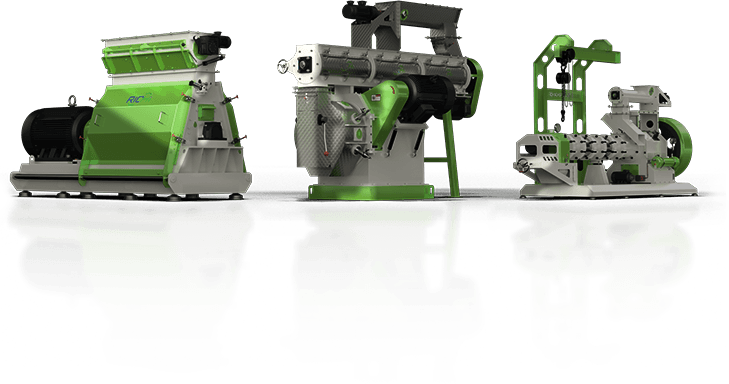
Beyond poultry feed, our solutions cover pelleting for ruminants, livestock, aquaculture, and pets. We deliver tailored production configurations and full-line support to ensure stable operations across diverse feed applications.
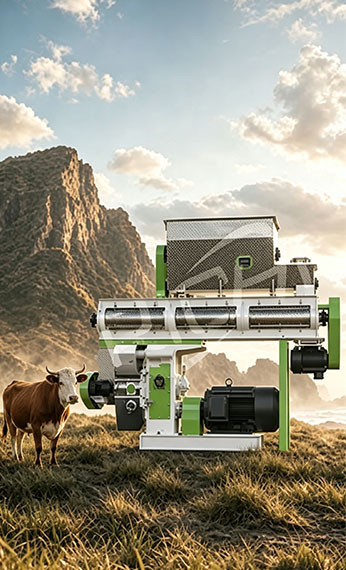
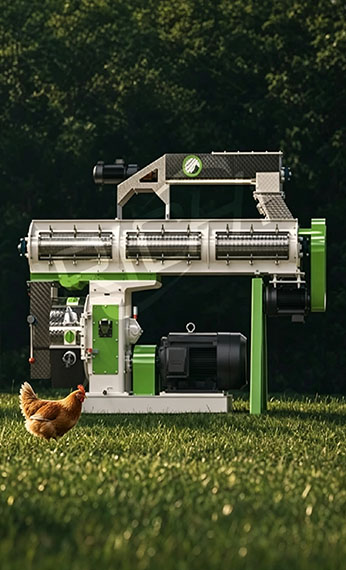
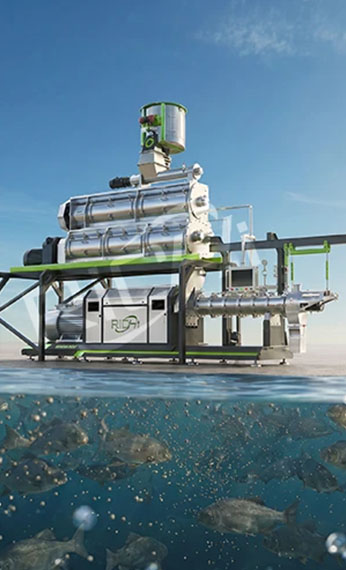
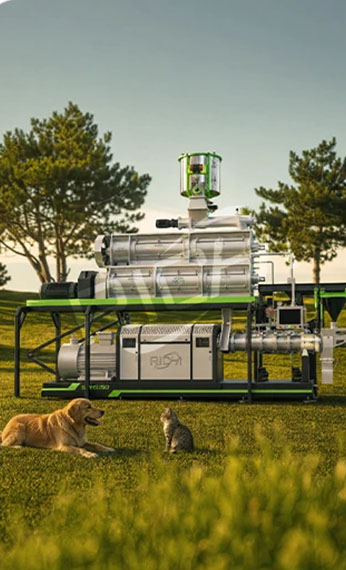
Pet food extruder machine

RICHI Machinery: Powering Global Pellet Production
Committed to pioneering pellet technology and industrial engineering, we leverage over 30 years of R&D expertise and global experience.
We optimize design, manufacturing, and system integration to drive the feed, biomass, and specialty industries toward efficiency, intelligence, and sustainability.
Our expert team delivers end-to-end pellet production solutions that meet international standards and align with your strategic goals for productivity and long-term growth.
60000 +m2
Square Meters of Our Factory
2000 +
Projects Running Worldwide
140 +
Countries of Our Client
200 +
Numbers of Our Team
Global Expertise & System Excellence
Advanced pellet production systems combine robustness and future-readiness, establishing industry benchmarks through technological integration and innovation.
Reliable Quality
Every machine undergoes precise and rigorous quality inspections.
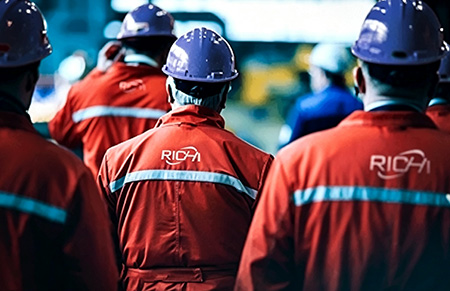
Worry-Free Warranty
Supported by a global service network with fast response times.
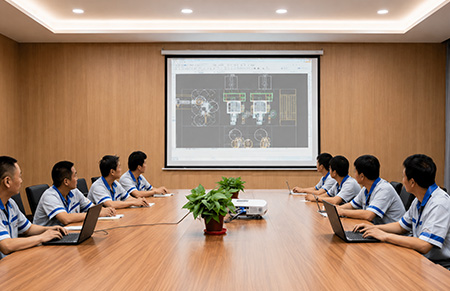
Professional Support
Experienced technical teams provide full-cycle assistance.

Secure Payments
Multi-layer encryption ensures safe and transparent transactions.

Global Logistics
Efficient worldwide shipping ensures timely delivery to any location.
Start Your Pellet Project
Pellet production is a systematic process. Provide your raw materials and capacity needs, and we’ll create a customized solution with professional guidance for commercial production.

Address: South of intersection of Xingda Road & Hongyuan Road, Wuzhi, Jiaozuo City, Henan Province,China

Tel/WhatsApp: + 86 136 0866 8310

E-mail: enquiry@richimachinery.com



© HENAN RICHI MACHINERY CO., LTD 1995-2026 Product Line-Up / Privacy Policy
Contact Us
Please send your requirements, RICHI’s consultants will get back to you quickly.

