Animal Feed Manufacturing Process: Complete Guide to Feed Production Equipment
As global demand for high-quality animal feed continues to grow, feed manufacturers are under increasing pressure to improve production efficiency, reduce operating costs, and maintain consistent pellet quality. Whether producing poultry feed, livestock feed, ruminant feed, or specialty animal feed, modern feed mills rely on automated manufacturing systems to ensure every batch meets strict quality standards.
As global demand for high-quality animal feed continues to grow, feed manufacturers are under increasing pressure to improve production efficiency, reduce operating costs, and maintain consistent pellet quality. Whether producing poultry feed, livestock feed, ruminant feed, or specialty animal feed, modern feed mills rely on automated manufacturing systems to ensure every batch meets strict quality standards.
A complete animal feed production line is far more than a collection of individual machines. It is an integrated system that combines raw material handling, grinding, batching, mixing, pelleting, cooling, screening, and packaging into one continuous process. Selecting the right equipment and production layout is essential for maximizing productivity while maintaining feed quality.
This guide explains how modern animal feed is manufactured, the equipment required at each stage, and how to choose the right feed production solution for your business.
1. Why Modern Feed Mills Need Automated Production
Traditional feed production methods often rely on manual weighing, mixing, and handling, making it difficult to achieve consistent product quality. As production capacity increases, manual operations become less efficient and more prone to formulation errors, material waste, and inconsistent pellet quality.
Automated feed manufacturing systems solve these challenges by integrating intelligent batching, precise dosing, automated conveying, and centralized control systems. Every production step is monitored to ensure ingredients are accurately measured and processed according to the feed formulation.
Modern automation also offers several advantages:
- Improve production efficiency and reduce labor requirements.
- Ensure accurate ingredient dosing and consistent feed quality.
- Reduce raw material waste and production costs.
- Support continuous operation for medium and large-scale feed mills.
- Enable easy switching between different feed formulations.
For commercial feed manufacturers, investing in an automated production line is no longer simply an equipment upgrade—it is an investment in long-term productivity, product consistency, and business growth.
2. Raw Materials Used in Animal Feed Manufacturing
Animal feed formulations vary depending on livestock species, nutritional requirements, and market demand. However, most feed production lines are designed to process a wide variety of raw materials.
Common energy ingredients include:
- Corn
- Wheat
- Sorghum
- Rice bran
- Wheat bran
Protein sources commonly include:
- Soybean meal
- Cottonseed meal
- Rapeseed meal
- Fish meal
- Meat and bone meal
Additional ingredients may include:
- Vegetable oils
- Vitamins
- Mineral premixes
- Amino acids
- Salt
- Limestone
- Feed additives such as enzymes, probiotics, antioxidants, and buffering agents
Modern feed production equipment is designed to handle these materials efficiently while maintaining accurate ingredient proportions throughout the manufacturing process.
3. Complete Animal Feed Manufacturing Process
Although formulations differ, the overall manufacturing process remains similar for most commercial feed mills.
(1)Raw Material Receiving and Cleaning
Production begins with receiving and storing raw materials. Before entering the production line, impurities such as stones, metal particles, and dust are removed using cleaning equipment and magnetic separators to protect downstream machinery.
(2)Grinding
Raw materials are reduced to the required particle size using a hammer mill. Proper grinding improves ingredient mixing, nutrient availability, and pellet quality while reducing energy consumption during pelleting.
Particle size requirements vary depending on the type of feed being produced. Fine grinding is typically required for poultry and aquatic feed, while larger particles may be suitable for livestock feed.
(3)Batching and Weighing
Automatic batching systems accurately measure each ingredient according to the feed formula. PLC-controlled weighing systems help minimize formulation errors and ensure every production batch maintains consistent nutritional value.
(4)Mixing
The weighed ingredients are transferred into a feed mixer, where macro ingredients, micro ingredients, oils, vitamins, and additives are blended into a homogeneous mixture.
Uniform mixing is one of the most important factors affecting final feed quality. High mixing accuracy helps ensure every pellet contains the correct nutrient composition.
(5)Pelleting
The mixed feed enters the pellet mill, where steam conditioning improves material plasticity before compression through the ring die to form pellets.
Pellet diameter and density can be adjusted according to different livestock requirements, making pellet mills suitable for poultry feed, livestock feed, rabbit feed, and other animal feeds.
(6)Cooling
Fresh pellets leaving the pellet mill are hot and contain relatively high moisture. A counterflow cooler reduces pellet temperature and moisture content, improving pellet strength and extending storage life.
(7)Screening
A vibrating screener separates qualified pellets from fines and broken pellets. Recovered fines are typically returned to the pelleting process to improve raw material utilization.
(8)Packaging
The finished feed pellets are weighed, packed, sealed, and prepared for storage or shipment using automatic packaging systems.

4. Key Equipment for an Animal Feed Production Line
A complete feed manufacturing system usually consists of the following core equipment:
(1)Hammer Mill
Used to grind raw materials into uniform particle sizes before mixing.
(2)Automatic Batching System
Ensures accurate ingredient weighing and formula consistency through computer-controlled dosing.
(3)Feed Mixer
Provides fast and uniform mixing of powders, grains, additives, and liquid ingredients.
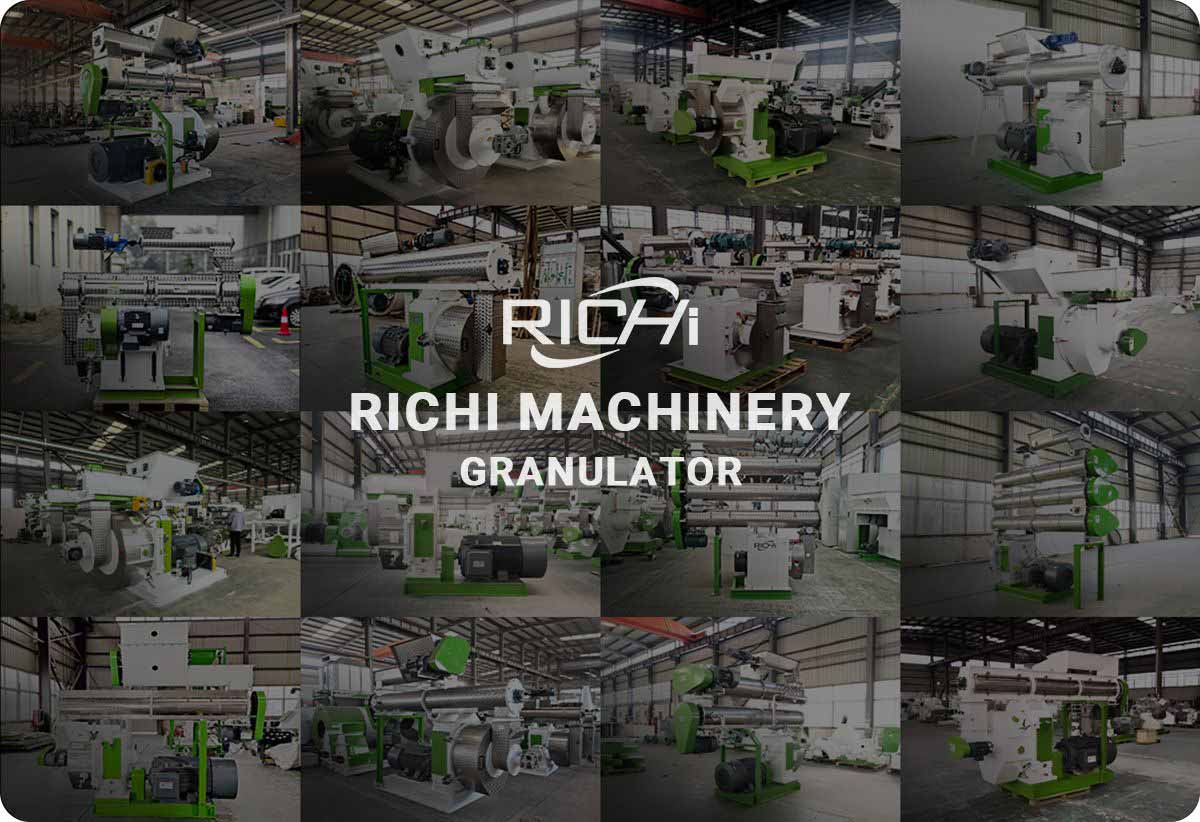
(4)Feed Pellet Machine
Compresses conditioned feed into durable pellets with consistent size and density.
(5)Counterflow Cooler
Reduces pellet temperature and moisture while improving storage stability.
(6)Vibrating Screener
Separates qualified pellets from oversized particles and fines.
(7)Automatic Packing Machine
Completes weighing, bagging, sealing, and packaging for finished products.
Together, these machines form a continuous production system capable of producing high-quality feed efficiently and consistently.
5. How to Choose the Right Feed Manufacturing Equipment
Selecting suitable feed production equipment depends on several important factors.
(1)Production Capacity
Choose equipment based on your planned output, whether you require a small feed mill or a large commercial production plant..
(2)Feed Type
Different feeds—including poultry feed, livestock feed, rabbit feed, cattle feed, and specialty animal feed—may require different processing parameters and equipment configurations.
(3)Raw Materials
The characteristics of raw materials directly influence grinding, mixing, conditioning, and pelleting performance. Equipment should be selected according to the materials you plan to process.
(4)Automation Level
Fully automated production lines reduce labor costs, improve production consistency, and simplify plant management, making them ideal for medium and large-scale manufacturers.
(5)Future Expansion
Selecting equipment with flexible layouts and scalable capacity allows manufacturers to expand production as market demand grows.
6. Build a Reliable Feed Production Line with RICHI
RICHI Machinery specializes in designing and manufacturing complete animal feed production lines for customers worldwide. From small feed mills to large industrial feed plants, we provide customized solutions covering equipment selection, plant layout, manufacturing, installation, commissioning, and technical support.
Our feed production systems are designed to process a wide range of raw materials and produce high-quality feed for poultry, livestock, rabbits, cattle, sheep, and other animals. With advanced automation, stable performance, and flexible configurations, RICHI helps feed manufacturers improve productivity while reducing operating costs.
Whether you are building a new feed mill or upgrading an existing production facility, our engineering team can recommend the most suitable equipment solution based on your raw materials, production capacity, and investment plan.
Contact RICHI today to discuss your feed manufacturing project and receive a customized production line solution.